Kia Dashboard Warning Lights Explained: What Each One Means
On a Kia, the colour of the warning light tells you what to do long before the symbol tells you what is wrong. Red means stop somewhere safe and switch the engine off — Kia's own definition is a light that "signifies immediate or imminent danger to persons or very serious damage to equipment". Amber, in Kia's own words, signifies that "something requires attention soon, since vehicle system malfunction or damage to vehicle may occur" — the car has found a fault, but you are not in immediate danger. Green and blue are information only: a system is switched on and working. Get those three rules right and you have made the correct decision before you have even worked out which icon you are looking at.
Key Takeaways
- Red = stop safely and switch off. Amber = book it in. Green/blue = information only. Kia's own published colour scheme.
- The oil pressure light is a pressure warning — not a service reminder, and not simply "you need oil". Kia says stop and switch the engine off.
- A flashing engine management light is a different message from a steady one — on petrol engines it signals a misfire severe enough to damage the catalytic converter.
- The red battery symbol is a charging-system warning, not a "your battery is old" light. Kia lists a broken fan belt and an alternator fault among the causes.
- The ESC symbol blinking as you drive is normal — Kia's manual says it blinks whilst the system is operating. The one that stays on is the fault version.
- Symbols follow an international standard (ISO 2575:2021), but the exact set varies by model, year and trim — a Picanto cluster is not a Sorento cluster.
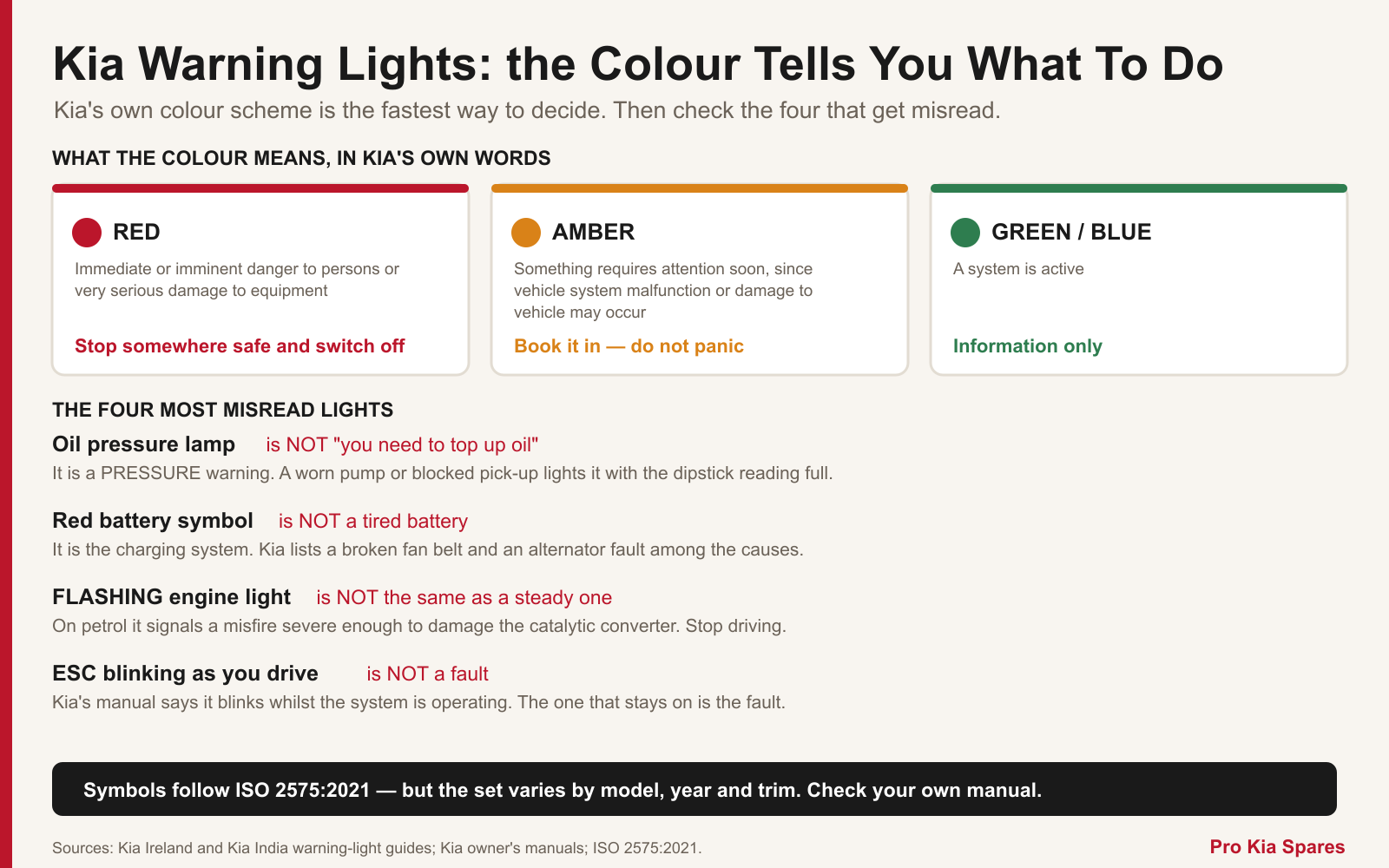
One caveat before the individual lights. The symbols and tell-tale colours are set out in an international standard, ISO 2575:2021 — which is why different makes use recognisably similar icons — but that does not guarantee every Kia shows the same set. Across a range running from a Picanto to an EV6, clusters differ by model, year, trim and whether a system is fitted at all. Confirm the symbol against the owner's manual for your specific car, not a generic chart.
Red lights: stop somewhere safe and switch off
Engine oil pressure — the one that ruins engines
Kia's manual is blunt: the light comes on "when the engine oil pressure is low", and the instruction is to "drive carefully to the nearest safe location and stop your vehicle. Turn the engine off and check the engine oil level."
Be clear what it measures — it is a pressure warning, not a top-up reminder. A low level is one cause of low pressure, which is why Kia tells you to check it. But a worn oil pump, a blocked pick-up strainer, a failed pressure switch or worn bearings will all light it up with the dipstick reading full. Topping up and carrying on is only right if the level genuinely was low and the light goes out and stays out. Some Kias separately show an oil level or service-interval message on the LCD screen; that is a maintenance prompt on a schedule, not this warning. If you cannot tell which you are looking at, switch off — an engine run without oil pressure for a few minutes is a rebuild.
Engine coolant temperature
The lamp itself carries no published temperature. Kia's manual says only that it comes on "when the temperature of the engine coolant is extremely high", with the caution "Do not continue driving with an overheated engine." Where a Kia does quote a figure it is the LCD screen doing it, not the lamp: the "Engine overheated" message appears when coolant is above 120°C (248°F), and "this means that the engine is overheated and may be damaged". Same split as the oil lights — the lamp is the alarm, the screen carries the detail. In stop-start traffic on a hot Durban afternoon a tired radiator fan, a failing thermostat or a slow coolant leak shows up here first, then clears the moment you get moving. That reprieve is the trap. Pull off, switch off, let it cool before touching the expansion tank cap.
Brake warning light
It illuminates with the parking brake applied. If it stays on with the parking brake released, Kia's manual says "it indicates the brake fluid level in reservoir is low", and tells you to stop and check the level immediately with the engine off. A falling level is either worn pads taking up caliper travel or a leak — only one of those is harmless. If the pedal also feels longer or softer than usual, stop driving.
Charging system (the red battery symbol)
Everyone reads this as "the battery is dying". Kia lists three causes: "the battery is exhausted", "the fan belt is broken", and "the alternator or electrical charging system is malfunctioning" — and tells you to check the alternator drive belt for looseness or breakage. On many engines that same belt drives the water pump, so a snapped belt gives you a red battery light and an overheating engine within a few kilometres.
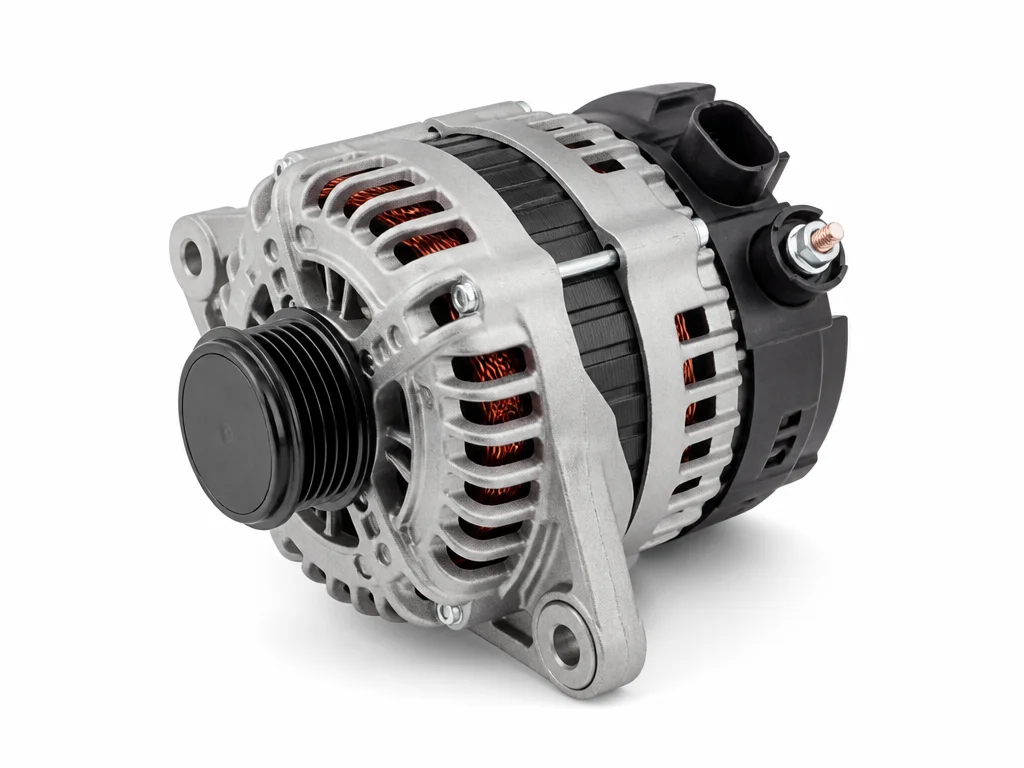
Kia alternators — tested units
If the red charging symbol stayed on after a new battery went in, the alternator is the usual answer. We carry tested used and new alternators across the Kia range.
Airbag / SRS
Red, but a different character. The car drives normally; the risk is that the restraint system may not do its job in a crash. Kia's guidance is short — "if the airbag warning light stays on, have your vehicle inspected by an authorized Kia dealer". Often it is a connector or clockspring rather than the airbag module, but it is not a light to live with.
Amber lights: book it in, don't panic
The engine management light (MIL) — steady versus flashing
Kia's manual says the malfunction indicator lamp comes on "whenever there is a malfunction with either the emission control system or the engine or the vehicle powertrain", and warns: "If the Malfunction Indicator Lamp (MIL) appears, potential catalytic converter damage is possible which could result in loss of engine power."
A flashing MIL is a separate message, and it is the urgent one. As the technician trade publication Vehicle Service Pros puts it: "The type 'A' misfire is the most serious condition and indicates impending catalyst damage. If detected, the Malfunction Indicator Lamp (MIL) may flash once per second to alert the driver that immediate service is required." A cylinder that is not burning its fuel sends raw petrol into the exhaust, where it lights off inside the catalytic converter and melts the substrate. Treat a flashing engine light as red behaviour on an amber symbol: get off the road rather than finish the trip.
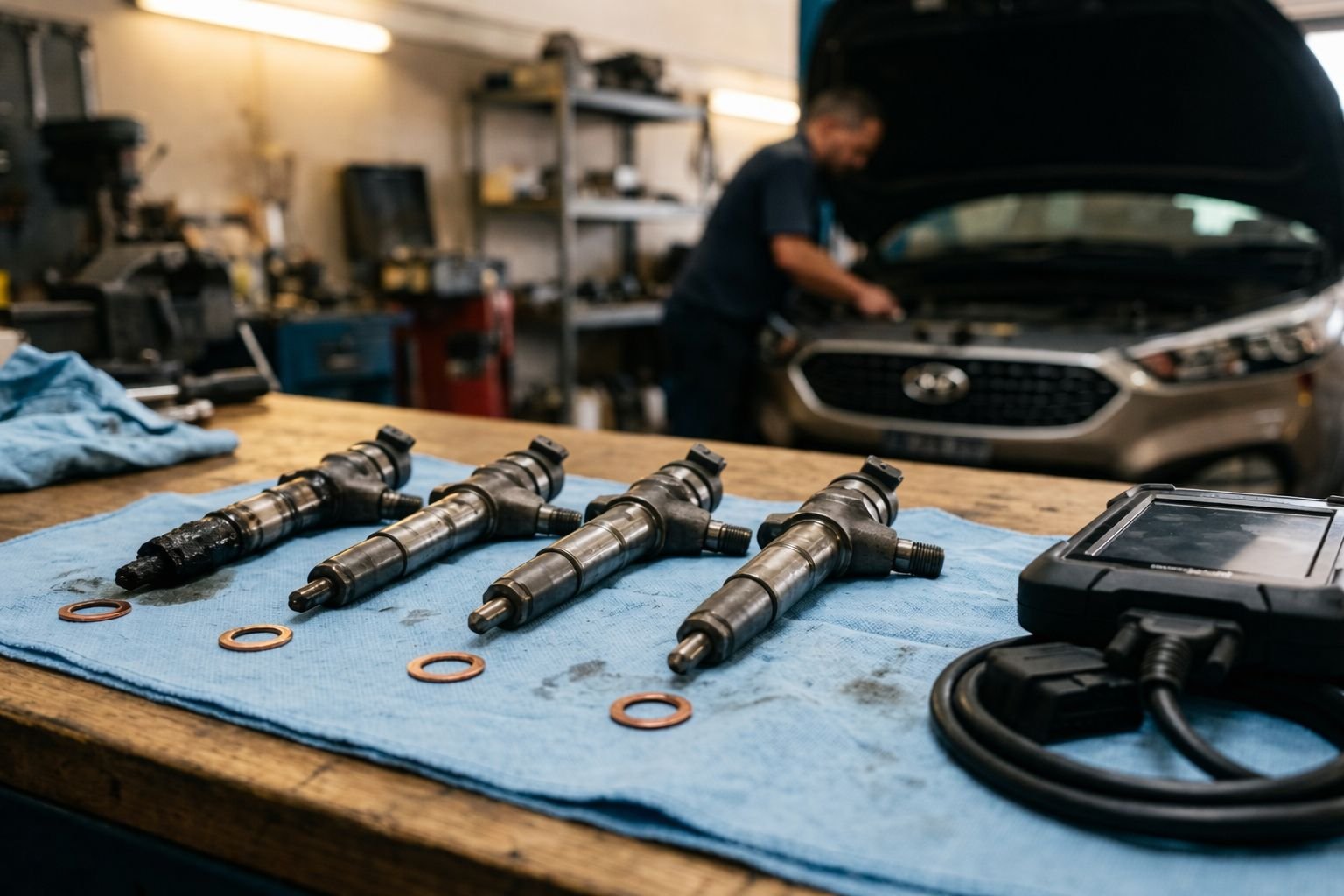
Diesel Kias complicate this. Kia describes a blinking MIL on a diesel as an error "related to the injection quantity adjustment", bringing loss of power, combustion noise and poor emissions. Separately, on cars fitted with a diesel particulate filter, the DPF light may go out on its own after driving above roughly 60 km/h, or above 2nd gear at 1 500–2 500 rpm, for about 25 minutes. On a CRDi model, read up on what failing injectors actually feel like first.
If the converter has already been cooked — the car will not pull, and there is often a smell of sulphur — you are shopping for a replacement catalytic converter as well as fixing the misfire.
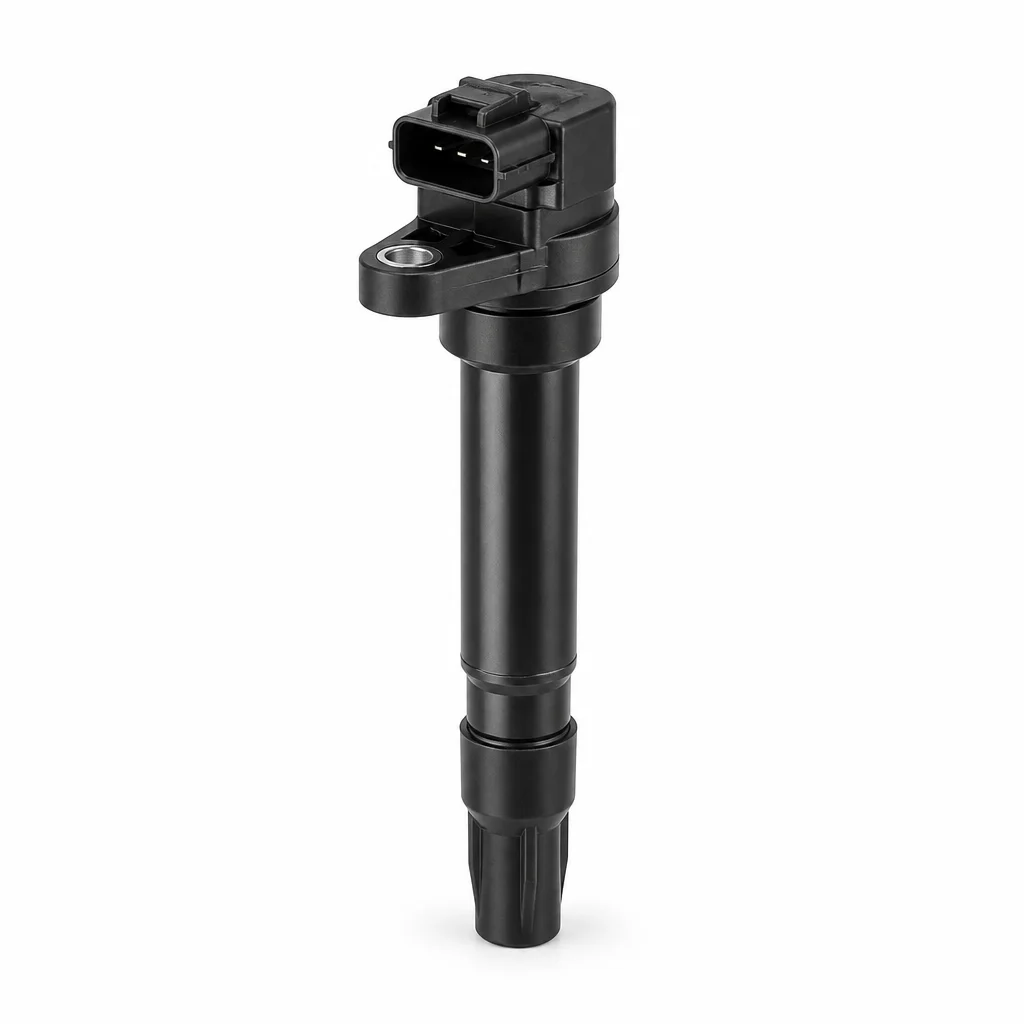
Ignition coils — the usual misfire culprit
A flashing engine light on a petrol Kia usually traces back to a coil, a plug or an injector on one cylinder. Coils are cheap next to a cooked catalytic converter.
ABS
Kia's wording is worth quoting in full: the light comes on "when there is a malfunction with the ABS (The normal braking system will still be operational without the assistance of the anti-lock brake system)". You still have brakes; you have lost the anti-lock function. Leave more following distance on wet tar and get it read — a dirty or failed wheel speed sensor is the common cause, a failed hydraulic module the expensive one.
There is also one South African recall worth knowing about here. On 8 December 2025 the National Consumer Commission published a recall covering 18,600 Kia vehicles sold here between 2009 and 2015, in which "the affected models require an ABS fuse replacement" — a defect the NCC says "could increase the vehicle's stopping distance to a standstill and, in some cases, lead to engine bay damage". The models listed are the Sportage (SL and KM), Sorento (XM), Optima (TF), Cerato (TD) and Soul (AM). The notice mentions no dashboard warning light, so do not read an ABS light on one of these cars as the recall — but the inspection and repair are free at an authorised dealership and worth booking regardless. If you want to know whether one specific car is on the list, you can check its VIN against Kia's open campaigns before you phone anyone.
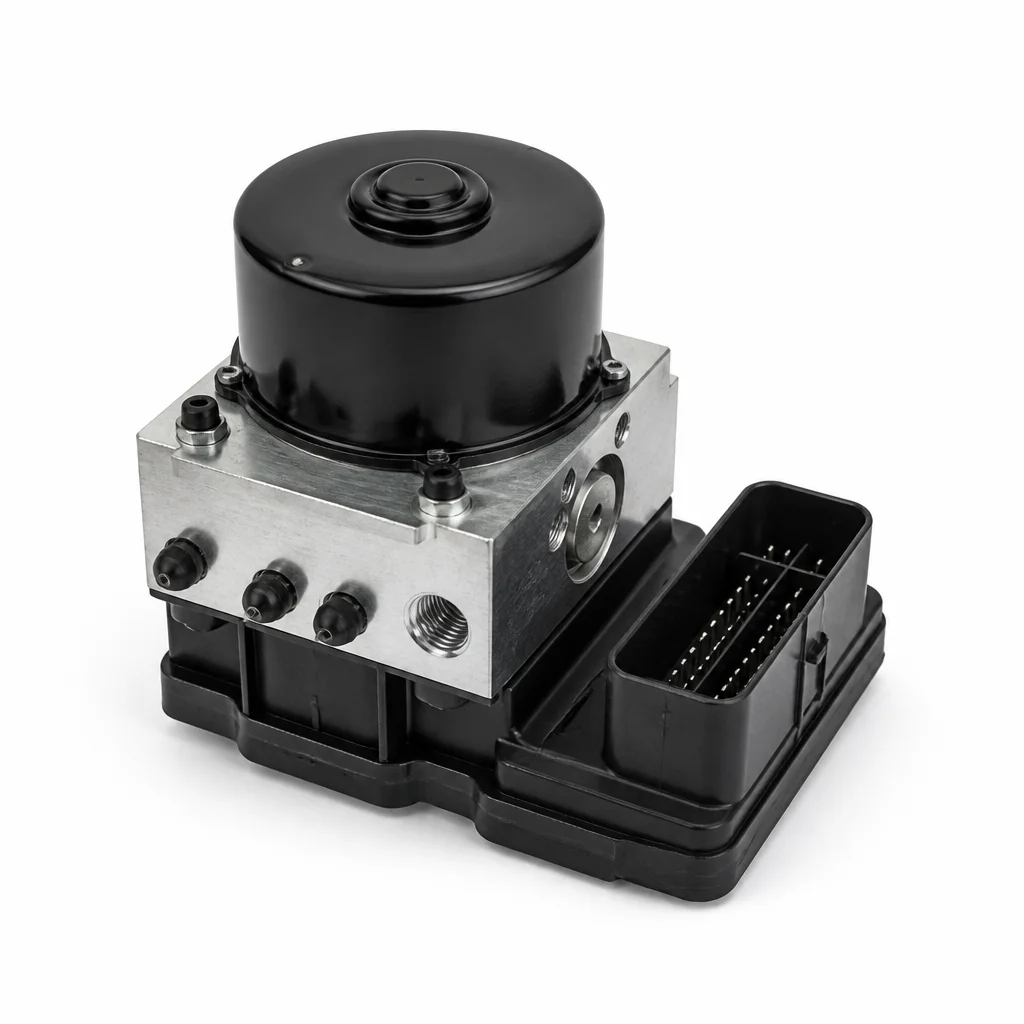
ABS modules and hydraulic units
Once the codes have been read and the fault is in the module rather than a sensor, we can source a matching used unit for most Kia models.
ESC and traction control
The light most often misread as a fault when it is the opposite. Kia's manual states the ESC indicator "blinks: whilst the ESC is operating" — a car symbol with skid marks flickering as you pull away on wet tar is the stability system doing its job, and Kia warns never to press the ESC OFF button while it is working. A separate ESC OFF symbol appears when you deactivate the ESC system by pressing the ESC OFF button. The version to worry about is one that comes on and stays on.
Tyre pressure monitoring (TPMS)
Kia says this appears "when one or more of your tyres are significantly under inflated", and does not soften the consequences: "Significantly low tyre pressure makes the vehicle unstable and can contribute to loss of vehicle control and increased braking distances." The manual goes on to warn that carrying on with under-inflated tyres will make them overheat and fail. On a long N3 run that is a safety warning, not a nag. Check all four with a gauge — and note not every model and trim has the system.
Power steering (EPS / MDPS)
Kia's entry is a one-liner: the light appears "when there is a malfunction with the EPS", and you should have the car inspected. In practice the steering does not fail — it goes heavy, because the electric assistance has dropped out. Manageable at speed, a real handful in a parking bay. Do not put off diagnosing it.
Glow plug / preheating indicator (diesel models)
The coiled symbol on diesel Kias is not a fault light in normal use. Kia's manual: "The engine can be started after the glow indicator light goes off. The illumination time varies with the engine coolant temperature, air temperature, and battery condition." On a cold Highveld morning it sits on noticeably longer than at the coast — that is the system working. It becomes a talking point when the car takes several attempts to start cold.
Worth knowing which cars this applies to here. South Africa's diesel Kias are the K2700 and K2500 bakkies plus the CRDi models — Sportage, Sorento, Cerato, Soul (from 2017), Seltos, the Sedona/Grand Sedona/Carnival line and the 2026 Carens. The Picanto, Rio and Sonet have never been sold here with a diesel, so there is no preheat light to look for on those.
Green and blue: information only
Kia's definition is one sentence: "It signifies that a system is active." Cruise control, ECO mode, lane keeping, the indicator repeaters — confirmations, not warnings. Blue is used for high beam. Nothing here needs action.
What we've seen in the yard
The pattern at the Briardene counter is almost never an exotic fault — it is a light that got driven on. Through July 2026 we quoted on three separate cylinder heads for Sportage and Sorento owners around Durban North and Pinetown, all in the 180 000–220 000 km bracket, and in each case the owner mentioned the temperature light had been "coming on in traffic" for a week or two beforehand. The red battery symbol gives the same story in reverse: a new battery goes in because the symbol looked like a battery, and weeks later we are quoting an alternator.
What to do when a light comes on
- Read the colour before the symbol. Red: somewhere safe, stop, switch off. Amber: drive sensibly, book it in. Green or blue: carry on.
- Note whether it is steady or flashing, and what else changed — a noise, a smell, the temperature gauge, the steering weight, the pedal.
- Get the codes read before buying anything. A code names a circuit, not a part: a lean-mixture code can be a vacuum leak rather than the oxygen sensor it seems to point at.
- Fix the cause, then clear the light. Clearing a code without repairing anything just delays it.
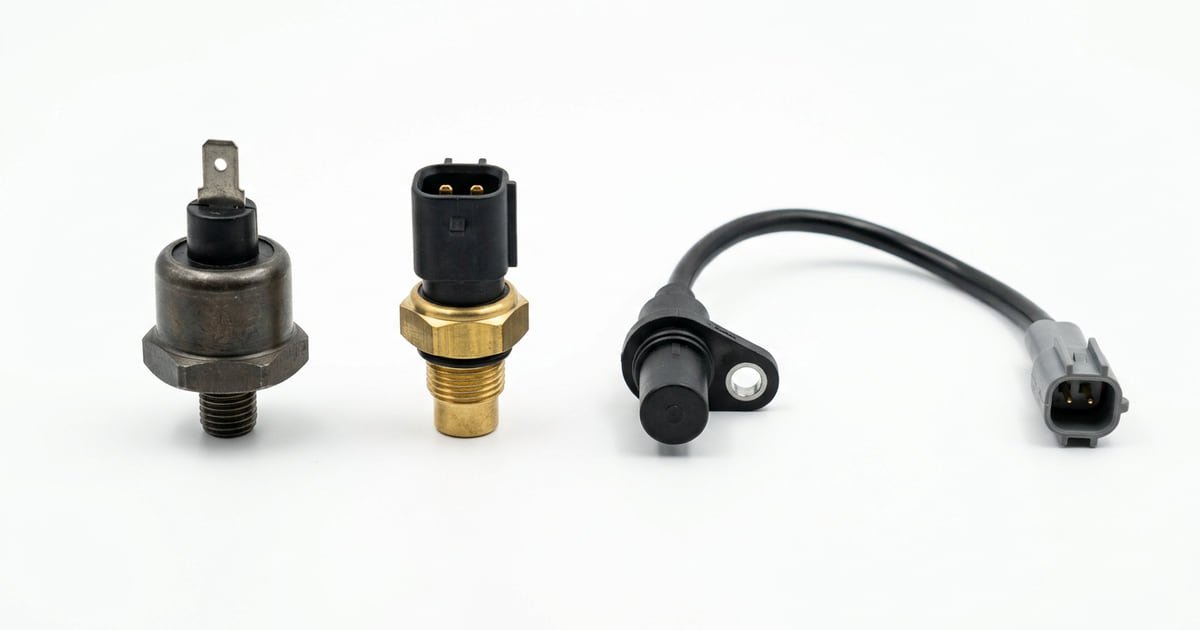
- Then source the part. Once the fault is confirmed we quote new or used electrical and electronics parts across the Kia range from our Durban North yard, with nationwide delivery.
Pro Kia Spares is an independent parts specialist operated by the Sparesboyz Group, not affiliated with Kia Corporation, Seoul. Nothing here replaces your owner's manual — for a diagnosis, use a qualified workshop.
Sources
- Kia Ireland — warning light colour definitions (https://www.kia.com/ie/service/warranty-guides/kia-warning-lights/)
- Kia India — warning and indicator lights, per-light guidance (https://www.kia.com/in/service/customer-awareness/warning-indicator-light.html)
- Kia owner's manual — warning lights: oil pressure, charging, brake, ABS, TPMS, MDPS, SRS (https://www.kia.com/content/dam/kia2/in/en/content/manuals/topics/chapter4_13_1.html)
- Kia owner's manual — indicator lights: ESC, ESC OFF, glow/preheat, high beam (https://www.kia.com/content/dam/kia2/in/en/content/manuals/topics/chapter4_13_2.html)
- Kia Carens owner's manual — MIL, catalytic converter warning, DPF drive cycle (https://www.kia.com/content/dam/kia2/in/en/content/carens-manual/topics/chapter4_15.html)
- Kia owner's manual — diesel blinking MIL and injection quantity adjustment (https://ownersmanual.kia.com/docview/webhelp/doc/907b96c5-1ca7-44e2-9039-353689ff3f43/topics/chapter4_12_1.html)
- Kia Seltos owner's manual — oil pressure and charging system procedures (https://ownersmanual.kia.com/full_webhelp/SP2/2025/en_US/topics/chapter4_21_1.html)
- Kia owner's manual — LCD "Engine overheated" message, above 120°C (248°F) (https://ownersmanual.kia.com/full_webhelp/MQ4A/2025/en_US/topics/t00213.html)
- Kia owner's manual — warning lights index, incl. engine coolant temperature (https://ownersmanual.kia.com/docview/webhelp/Kia/f341457d-e95b-4f5d-82bd-c150e85833d7/topics/t00246.html)
- Vehicle Service Pros (Motor Age) — Type A misfire and the flashing MIL (https://www.vehicleservicepros.com/service-repair/diagnostics-and-drivability/article/21171135/misfire-detection)
- ISO 2575:2021 — Road vehicles: symbols for controls, indicators and tell-tales, 9th edition, September 2021 (https://www.iso.org/standard/68409.html)
- National Consumer Commission (South Africa), 8 December 2025 — ABS fuse recall (https://thencc.org.za/product-recalls-jeep-wrangler-and-various-models-of-kia-vehicles/)